
Club RowStudio is about never quitting. Seeing the opportunity in failures and successes alike. Improving your health is a lifestyle: and Club RowStudio is here to give you full control.
View your latest performance data
Track and measure your performance, to become your very best.
Click this button in the menu to go to your dashboard!

NEWS

COMMUNITY
Get to know your trainers – meet Kim
Kim is a force to be reckoned with on the indoor rowing machine. Standing at 186 cm tall, Kim started rowing when she was 19. Her ability was soon recognized and she joined the Dutch national team. But after finding it difficult to combine with her studies in medicine, Kim hung up the national team oars and has been focusing on staying fit.
“Right now it’s about being fit and strong,” Kim says. “I do most of my training at Row Studio and on the racing bike, with a few extra weight workouts.”
When she walks into a RowStudio workout, either as a teacher, or a participant, she is ready jump into the action.
“I start easy, just to warm up, but my goal is always to hit my max watts,” she says. So, what is Kim’s max power?
About 660 watts! If you want to know more about what that means, read into watts here.
But Kim says that no matter what your max is, you should always set yourself goals during class.

“Once you’ve been to a few classes, and you know what you can do, it gets easier. Start easy to warm up, but when you see a power pyramid coming, try to add 5 or 10 watts with every step and see how far you can go.”
And Kim’s advice for people who feel stuck at their max watts?
“If you have some experience, you can try is adding a bit more resistance. If that’snot possible, try to focus on your technique and really using your core. But also, you won’t be able to hit your max every class, and that’s ok too,” she says.
Book your next class with Kim soon!
MASTER YOUR DATA

Everything you need to know about the Watt
In the middle of your RowStudio workout you look at the screen and a giant number is staring back at you: The Watts. But what is a Watt and how should you use it to determine your performance?

How to measure your performance by a ‘split’?
The ‘split’ is a common measurement in the rowing world. It is a measure of the amount of time it takes to row a distance of 500 meters. On the RP3 machine, a time of two minutes per 500 meters is displayed as: 2:00/500m.
On-water rowing races take place over a standard 2000-meter distance. This distance is divided into four 500-meter segments. The time per 500 meters has been set as a common measurement of rowing performance.
Did you know? The world record time for a man over 2000 meters is 5:35.8, that means an average split of 1:23.9 for more than 5 minutes. For a woman it is 6:22.8, which is a 1:35.7 split. Can you reach those numbers for one stroke during your next class?
 The split is related to *Watts via a complicated formula. Luckily, the machine translates the numbers for you directly. As your Watts, or power output, goes up, your split will decrease. If you were rowing on the water, you would be moving the boat faster!
Similarly to Watts, it is difficult to estimate what to aim for because factors such as fitness level, technique and height/weight play an important role. However, below you will find some general guidelines.
Average woman, 165cm, 65kg
Aerobic rowing: 2:25/500m
Sprint rowing: 1:55/500m
Average man, 180cm, 85kg
Aerobic rowing: 2:05/500m
Sprint rowing: 1:35/500m
Take a look at your split the next time you are on the rowing machine. The harder you drive through your legs, the faster you will go (that means the number will decrease). Remember to focus on improving your best split as your fitness level increases!

Adjusting the resistance to better your performance
You want to improve speed, increase endurance and build muscle as fast as possible, right? When you sit down on the rowing machine for your RowStudio workout, you might be tempted to set the resistance to the highest setting, but before you do that, read on.

Speed up or slow down? Determining your stroke rate
The rowing machine is full of numbers and data. We’ve already covered the amount of power or *watts, and the amount of time it takes to row 500 meters or *split. But another determining factor in the amount of effort given during a class is the stroke rate, or the number of strokes per minute (spm).

Going the distance – track your meters at RowStudio
The RowStudio dashboard gives you insights about the number of meters you row every class! So, what should you aim for?

The quest for a perfect curve: a force curve
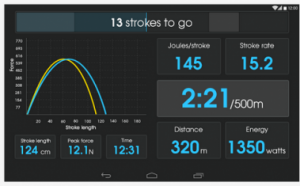
The force curve is shown on a small graph that appears on your screen while training. The y-axis is power and the x-axis is time, so you’ll see how you generate power throughout one stroke’s drive.
What are you looking for? The ideal curve would actually be a rectangle. That would indicate immediate full power application, sustaining the power all the way through the drive, and then the complete relinquishing of power as you move into the recovery. Yet, this is humanly impossible.
Instead, you want to aim for the closest alternative, a parabolic-type curve. Think of an upside-down u shape. As you drive your legs, the curve will go up to its peak point. As your body and arms come into the stroke, the curve will decrease from its peak back down to zero at the end of the stroke.
Here are two important tips:
- Try to remove any bumps in the curve. Bumps are an indication of lost power.
- Try to maintain a consistent and symmetrical curve. You don’t want too much power at the beginning and then it trails off dramatically at the end, or too little power at the beginning and it becomes much bigger at the end.

In order to do it correctly, think about pushing with legs then engaging the core and hips all the way through to the finish. And stay tuned for our post on rowing technique.
Did you know? The force curve is one of the most hotly debated subjects in rowing biomechanics. Coaches from around the world debate the exact shape the curve should have, but the tips provided here are agreed upon by all!

